Updated November 2026 · sources linked
At a glance
- The Iranica names Kashan, Nain and Qom (Ghom) as places where carpets are made entirely of silk. Wikipedia adds Isfahan for silk pile.
- Kashan is the oldest silk centre of the four: Britannica attributes three groups of Safavid all-silk carpets to it.
- For the 20th century, Isfahan and Nain are known above all for fine wool carpets with a silk component. The Iranica dates Isfahan’s new beginning to about 1921.
- Qom is the youngest centre and the only one that the trade associates almost exclusively with the pure silk carpet.
- No specialist source examined offers a structural rule of identification that reliably distinguishes Qom from Kashan.
Kashan, Qom (Ghom, Qum, Kum; Persian قم), Nain and Isfahan all lie in central Iran, and all four knot very fine carpets. In the trade they are often mentioned in the same breath. Anyone faced with a fine silk carpet is therefore right to ask where it comes from. This article compares what the specialist literature says about the four centres. It also shows candidly where a reliable distinction is not possible on the present state of the sources.
The four cities at a glance
The Iranica names three places in central Persia where carpets are made entirely of silk: Kashan, Nain and Qom (Iranica, Carpets ii). The English Wikipedia names high-quality carpets from Kashan, Qom, Nain and Isfahan with a pure silk pile (Wikipedia: Persian carpet). The German Wikipedia names Kashan, Qom and Nain as places of very finely knotted carpets (Wikipedia: Perserteppich).
| Kashan | Qom | Isfahan | Nain | |
|---|---|---|---|---|
| Earliest evidence for carpets | 16th c., Safavid silk carpets | carpets in the mausoleum of Shah Abbas II, 1082 AH (1671/72); place of weaving open | late 16th c., court workshops under Shah Abbas I | 20th c. in the sources examined |
| Modern beginning | large commercial production “with the beginning of the 20th c.” | 20th c., exact date unattested | circa 1921 (Iranica) or second quarter of the 20th c. (Britannica) | mid-20th c. (Britannica) |
| Foundation according to specialist source | silk or cotton, depending on the pile | no specialist information; auctions: silk | cotton or silk, depending on quality | no specialist information |
| Pile | wool or silk | mainly silk; also wool (“kork”, trade claim) | wool, according to Wikipedia “kork wool”; pure silk pile in high-quality pieces | wool (Wikipedia); pure silk pile in high-quality pieces (Wikipedia) |
| Knot | asymmetrical | asymmetrical (trade claim) | asymmetrical | asymmetrical (Wikipedia) |
| Typical colours according to source | red in the small Safavid silk carpets | blue, red, ivory (Wikipedia) | cream ground, brick-red border | not attested |
Sources for the table: Britannica: Kashan carpet; V&A, T.438-1976; Britannica: Esfahan carpet; Iranica, Carpets xii; Wikipedia: Qom rug; Wikipedia: Nain rug; Wikipedia: Isfahan rug; shahmansouri.com (trade claim, asymmetrical knot in Qom).
Examples in the trade: Silk rugs at BazarPort (our own shop)
Kashan: the old silk centre
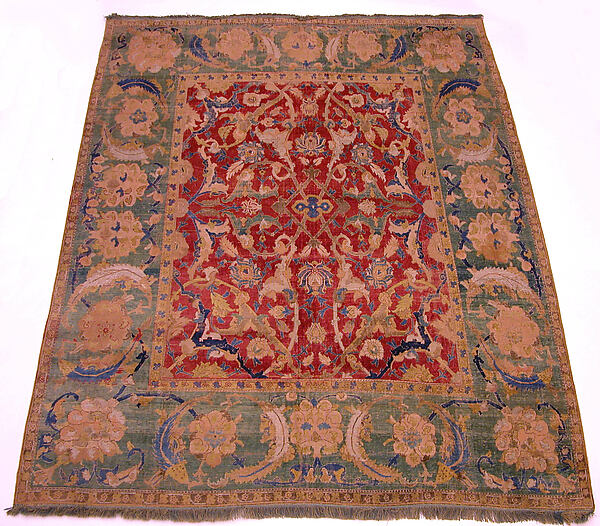
Kashan has the deepest silk history. Britannica attributes to the city three groups of Safavid all-silk carpets of the 16th century: three large medallion and hunting carpets, more than a dozen small silk carpets with a strong red, and silk tapestry-woven carpets (Britannica: Kashan carpet). The best known is the hunting carpet in the MAK in Vienna (Iranica, Carpets ix). The Metropolitan Museum names some twenty surviving carpets of this kind, four of them in New York (Met, 58.46).
After that the record breaks off. According to Britannica, nothing is known of Kashan carpets of the 17th to 19th centuries. With the beginning of the 20th century a large commercial production arose in wool and silk. Knotting is asymmetrical, on a silk or cotton foundation, depending on the material of the pile. Most of the dye in more recent carpets, it says, is synthetic.
Kashan is, moreover, the only one of the four cities with a UNESCO inscription. In 2010 the traditional skills of carpet weaving in Kashan and Fars were inscribed on the lists of intangible cultural heritage (Wikipedia: Persian carpet). More on this in the article Kashan carpets.
Isfahan: court city with a late new beginning
Isfahan became the capital under Shah Abbas I at the end of the 16th century. According to Britannica, many of the finest carpets woven with gold and silver thread of the later 17th century came from there (Britannica: Rug and carpet – Persia).
The modern new beginning is well dated. Floor writes in the Iranica that Isfahan became a major carpet centre around 1300 SH/1921, as a latecomer with an eye to European and American markets (Iranica, Carpets xii). Britannica names the second quarter of the 20th century. Modern Isfahan carpets, it says, are closely clipped and thin, usually on a cream ground with a hard brick-red border. The foundation is cotton or silk, depending on quality (Britannica: Esfahan carpet). More in the article Isfahan carpets.
Nain: from cloak fabric to the fine carpet
Nain is closely linked with Isfahan. Floor mentions that by around 1921 the production of aba in Nain had ceased; these traditional cloaks had been an important source of income (Iranica, Carpets xii). Britannica writes that in the mid-20th century carpets similar to those of Isfahan were made in Nain, in extremely fine knotting (Britannica: Esfahan carpet). The English Wikipedia names a beginning shortly before the Second World War, a wool pile and Shah Abbasi designs, but relies only on a dealer’s book of 1962 (Wikipedia: Nain rug). More in the article Nain carpets.
Qom: the youngest centre
In the specialist literature Qom is the least well documented of the four centres. Floor describes a growing village production: eleven weaving villages in 1948, some 5,000 people employed in 1966 (Iranica, Carpets xii). For the 1970s he names Qom on a par with Kerman, Tabriz, Kashan and Nain. Modern auction lots describe Qom silk carpets with a silk foundation (Chiswick, Lot 84).
One dealer writes that Qom’s technique is similar to that of Kashan (persianrugs.com.au, trade claim). Several dealers’ texts trace Qom weaving back to migrants from Kashan. No specialist source for this origin was found. The state of research is summarised in the article Qom carpets: history and origins.
The sources disagree
For Nain there are three starting dates. Floor describes the end of aba weaving around 1921, but names no beginning of carpet knotting in Nain (Iranica, Carpets xii). Wikipedia gives “shortly before the Second World War” (Nain rug). Britannica speaks of the middle of the 20th century (Esfahan carpet). For Isfahan, too, the Iranica (circa 1921) and Britannica (second quarter of the 20th century) differ slightly. For Qom an attested starting date is lacking altogether. A sequence “Kashan before Isfahan before Nain before Qom” can therefore be drawn only roughly.
What makes the distinction difficult
The same construction
The specialist sources describe the same logic for Kashan and Isfahan. The foundation follows the material and quality of the pile (Britannica: Kashan carpet; Britannica: Esfahan carpet). All four centres knot asymmetrically. A pure silk warp or a silk pile alone therefore does not reveal the place of origin.
The same designs
The designs overlap as well. The Iranica assigns the shah-abbasi design to workshops in Tabriz, Kerman, Nain and Isfahan (Iranica, Carpets iv). Dealers name the same design for Qom (rugman.com, trade claim). According to the trade’s own account, Qom adopts the designs of other centres (persianrugs.com.au, trade claim). Details in the article Qom designs.
Similar density
Knot density does not reliably separate the cities either. One dealer writes that only Isfahan and Nain reach a similarly high average density to Qom (bakhtiyar.com, trade claim). For Isfahan, Wikipedia gives up to one million knots per m² (Wikipedia: Isfahan rug), for Nain 250 to 500 KPSI, that is, roughly 390,000 to 775,000 knots per m² (Wikipedia: Nain rug). European auction houses usually state Qom silk at 800,000 to 1.2 million knots per m² (Dorotheum; Dorotheum). The ranges overlap. For the conversion see knot density in Qom carpets.
Useful indications
Despite these overlaps, the sources offer some pointers. None is conclusive on its own.
- Material of the pile. A carpet entirely of silk is most consistent with Qom, Kashan or Nain, the places the Iranica names for pure silk carpets. For Isfahan and Nain the sources examined describe a wool pile as the normal case (Wikipedia: Isfahan rug; Wikipedia: Nain rug).
- Signature with place name. Many Qom workshops knot the city name into the signature, for instance “Ghom Daneshpoue” (Dorotheum). According to the trade, the same applies to workshops in other cities (rugman.com, trade claim). See Signed Qom carpets.
- Overall palette. Britannica describes Isfahan with a cream ground and a brick-red border. Wikipedia names blue, red and ivory for Qom. These are tendencies, not rules.
- Age. On the present state of the sources, a silk carpet securely dated before 1900 is hardly likely to be a modern Qom. Dealers’ dates such as “Qom circa 1900” remain unsubstantiated.
No specialist source examined names a structural rule that reliably separates Qom from Kashan. For a single Kashan workshop, Mohtasham, Christie’s describes identifying features such as a purple silk selvedge (Christie’s Collecting Guide). Comparable features for Qom workshops have not been published.
Related topics
- Kashan carpets: from the Safavids to Mohtasham
- Isfahan carpets: court art and fine workshop carpets
- Nain carpets: from aba weaving to the fine carpet
- Qom (Ghom) silk: material, foundation and sheen
- Safavid silk carpets from Kashan
Sources
- Carpets ii. Raw materials and dyes (Jasleen Dhamija) – Encyclopaedia Iranica
- Carpets iv. Designs, motifs and patterns (Annette Ittig) – Encyclopaedia Iranica
- Carpets ix. Safavid Period (Daniel Walker) – Encyclopaedia Iranica
- Carpets xii. Pahlavi Period (Willem M. Floor) – Encyclopaedia Iranica
- Kashan carpet – Britannica
- Esfahan carpet – Britannica
- Rug and carpet: Persia – Britannica
- Silk Kashan Carpet, 58.46 – The Metropolitan Museum of Art
- Carpet, T.438-1976 – Victoria and Albert Museum
- Middle Eastern rugs and carpets: collecting guide (Louise Broadhurst) – Christie’s
- Lot: Ghom silk, hunting scenes, 21.10.2020 – Dorotheum
- Lot: Ghom silk 11 x 11, 24.02.2023 – Dorotheum
- Lot 84: Signed silk Qum rug, 24.03.2026 – Chiswick Auctions
- Persian carpet – Wikipedia
- Perserteppich – Wikipedia (German)
- Qom rug – Wikipedia
- Nain rug – Wikipedia
- Isfahan rug – Wikipedia
- Qum – persianrugs.com.au (trade claim)
- Qum rugs – Rugman (trade claim)
- Qum Rugs: The Definitive Guide – Bakhtiyar (trade claim)
- Qom Rugs – Shahmansouri (trade claim)