Updated November 2026 · sources linked
At a glance
- According to Britannica, Qom (Ghom) lies 147 km south of Tehran on the edge of the Dasht-e Kavir salt desert and had some 1.2 million inhabitants in 2016.
- The rise of the city begins with the tomb of Fatima, the sister of the eighth Imam, who died here in 201 AH (816/17).
- The Safavids enlarged the shrine and had themselves buried there. The mausoleum of Shah Abbas II was furnished with silk carpets.
- The Iranica article on the city mentions textile crafts for the 9th and 10th centuries, but neither silk nor carpets.
- None of the sources examined explains why the pilgrimage city in particular became a centre of silk carpets in the 20th century.
Qom (Ghom, Qum, Kum; Persian قم) is first a holy city and only then a carpet town. Its shrine draws pilgrims, and its seminaries shape the religious scholarship of the country. In the carpet trade, by contrast, its name stands for fine silk. This article tells the history of the city on the basis of attested sources. It also asks how the two sides of Qom are connected, and shows where the sources give no answer.
Location and form
Qom is the capital of the province of the same name in north-central Iran. The city lies on both banks of the Rud-e Qom river and borders on the Dasht-e Kavir salt desert (Britannica: Qom). It lies on the Trans-Iranian Railway and has road connections to Tehran, Arak, Kashan, Saveh and Yazd. In 2016 it had 1,201,158 inhabitants.
In Persian the name is written قم, pronounced Qom (Wikipedia: Qom). In the German carpet trade the spelling “Ghom” has become established, in the English-speaking trade “Qum” or “Qom”.
The sources disagree
Even the distance to Tehran is given differently. Britannica gives 147 km (Qom). The English Wikipedia gives 140, 125 and 156 km in the same article (Qom). The Wikipedia article on Qom carpets and one dealer give around 100 km (Qom rug; bakhtiyar.com). The differences probably arise from straight-line distance, road kilometres and different reference points. The Britannica figure is the only one of unambiguous origin.
Examples in the trade: Qom silk rugs at BazarPort (our own shop)
From settlement to city
The Iranica article on Qom is by Andreas Drechsler. He traces the history of the place back to antiquity (Iranica: Qom). In Sasanian times, he writes, Qom was a small administrative unit with villages and small towns. The first permanent Arab settlers came during the uprisings of 685 to 696. Later Ashʿarites from Kufa moved in, an Arab group that left its stamp on the city. Harun al-Rashid separated Qom administratively from Isfahan in 189 AH (804/05). From the beginning of the 9th century, according to Drechsler, Qom met the criteria of a city.
The economy of this period rested on agriculture and irrigation. For the 10th century Drechsler gives 51 mills and at most 50,000 inhabitants. Crafts are documented: chairs, textiles and saddlery. The article mentions neither silk nor carpets.
For the late 15th century Drechsler relies on the travel account of Giosafat Barbaro, who spoke of 20,000 houses. This would give some 100,000 inhabitants, provided Barbaro’s figure is correct.
The tomb of Fatima
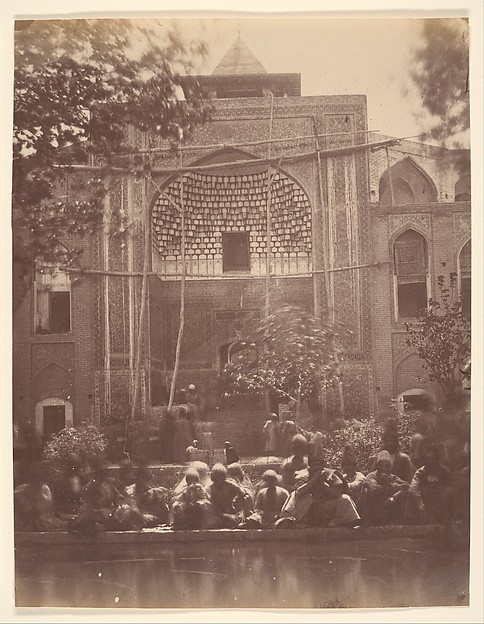
The city’s standing rests on a tomb. Fatima, the sister of the eighth Imam ʿAli al-Riza, died in Qom in 201 AH (816/17), according to the Iranica, on her way to join her brother in Khorasan (Iranica: Qom). From 256 AH (869/70) a building arose over her tomb, from which the shrine developed. Britannica gives 816 as the year of her death (Britannica: Qom).
Under the Safavids the shrine was generously enlarged. According to Wikipedia, Tajlu Khanum, a wife of Shah Ismaʿil I, directed a rebuilding in 1519 with an iwan, two minarets and an octagonal tomb chamber (Wikipedia: Fatima Masumeh Shrine). The Qajar ruler Fath-Ali Shah had the golden dome restored in 1803. Britannica attributes the gold-crowned building generally to the Safavids. According to Wikipedia, millions of Shiite Muslims make the pilgrimage to Qom every year.
Royal tombs and silk carpets
Qom also became a burial place for rulers. Britannica speaks of about ten kings and 400 saints buried in and around Qom (Britannica: Qom). According to Wikipedia, six members of the Safavid dynasty lie in the shrine (Wikipedia: Fatima Masumeh Shrine).
For the history of carpets one tomb matters above all. Shah Abbas II died in 1666 and was buried in a mausoleum of his own. The Victoria and Albert Museum describes its furnishings (V&A, T.438-1976). Twelve almost identical small silk carpets lined the walls of the twelve-sided room. A carpet with metal threads lay over the tomb, a large twelve-sided carpet in the centre. According to the museum, one of the wall carpets bears the inscription of the master Nimatullah Jawshaqani and the year 1082 AH (1671/72).
| Object | Date | Present location according to source |
|---|---|---|
| Silk wall carpet, approx. 133 × 69 cm, silk on silk | 1671–1672 | V&A London, T.438-1976 |
| Large twelve-sided central carpet, silk | 1671 | Museum of the Hazrat Masumeh shrine, Qom, no. 1400 |
| Carpet with metal threads over the tomb | not stated | not stated |
Sources: V&A; Iranian Journal for the History of Islamic Civilization.
Britannica calls these carpets the last truly fine achievements of Persian carpet weaving (Britannica: Rug and carpet – Persia). A study of 2023 describes the central carpet as the largest Safavid silk carpet. It sees its design as influenced by the ceiling decoration of the tomb chamber (Iranian Journal for the History of Islamic Civilization). Whether the carpets were knotted in Qom is not attested. More on this in the article Qom carpets: history and origins.
The city of scholars
In the 20th century Qom became the most important centre of Shiite scholarship in Iran. According to Wikipedia, the modern seminary, the hawza, is barely a century old (Wikipedia: Qom). It was revived by Abdul-Karim Haeri Yazdi and later by Grand Ayatollah Borujerdi. Britannica names the largest madrasa in the country, where Islamic law, philosophy, theology and logic are taught. After the revolution of 1979 Ayatollah Khomeini made Qom his seat (Britannica: Qom).
The carpet weaving of the region grew in the same decades. None of the sources examined describes a connection between the two developments.
The economy today
Britannica describes Qom as an industrial city with textile, petrochemical, cement and brick industries (Britannica: Qom). The city is a regional hub for the distribution of petroleum. In 1956 oilfields were discovered near Sarajeh. In the surrounding area wheat, barley, oilseeds, vegetables, fruit and cotton are grown. The English Wikipedia stresses the dependence on pilgrim traffic (Wikipedia: Qom).
Neither of the two city articles mentions carpets. The only scholarly description of the Qom carpet economy is found in a different Iranica article.
How the pilgrimage city became a carpet city
In the Iranica, Willem Floor describes weaving in the Qom area on the basis of the fieldwork of the geographer Marcel Bazin (Iranica, Carpets xii). In 1948 only eleven villages around Qom knotted carpets. In 1966, 3,671 of 10,036 households were involved, some 5,000 people, predominantly women and girls. The municipal administration organised the trade and supplied materials and designs. In 1969 carpets brought in 20 to 40 per cent of family income.
This organisation is remarkable. According to Floor, it was not private dealers but the municipality that supplied the designs. This could explain why Qom did not develop a village design of its own, but knots models from other centres. This connection is an interpretation, not a statement of the source. More on the designs in the article Qom designs.
For the urban silk workshops, the trade and Persian sources name migration from Kashan. The Iranian portal Beytoote speaks of weavers from Kashan and Isfahan who brought designs, looms and export contacts with them (beytoote.com). In an oral-history session in 2022 the master Mohammad Jamshidi said that his father came from Kashan (Hawzah News). The association chairman Sadeghi spoke there of more than a century of carpet and silk work in Qom. The road connection to Kashan is documented (Britannica: Qom). The migration is thus well attested in tradition, but not documented by scholarship. More in the article Qom carpets: history and origins.
The silk, too, has no attested roots in Qom. The Iranica article on silk names Gilan and Mazandaran as the main rearing areas, together with some oases of central Iran such as Kashan, Natanz and Yazd (Iranica, Silk ii). Qom is not among them. The raw material therefore probably came from outside. This follows from the silence of the source, not from an explicit statement.
The sources disagree
The three Iranica articles on the city, silk and carpets do not paint a common picture. The city article mentions no carpets (Iranica: Qom). The silk article does not name Qom among the silk-carpet centres (Silk ii). The article on raw materials, by contrast, expressly names Qom as a place of pure silk carpets (Carpets ii). The articles were written between 1983 and 2009 and deal with different periods. Above all, the contradiction shows how young and little researched silk weaving in Qom is.
Visiting Qom
The shrine is an active religious site. According to Wikipedia, it is heavily visited on every day of the year (Wikipedia: Fatima Masumeh Shrine). According to the 2023 study, the large tomb carpet of Shah Abbas II is in the shrine’s museum (Iranian Journal for the History of Islamic Civilization). Opening hours and access rules for foreign visitors were not given in any source examined. Please consult official bodies before travelling.
Related topics
- Qom (Ghom) carpets: history and origins of a young weaving town
- Qom designs: Shah Abbasi, hunting, gol-farang, kheshti, prayer
- Qom (Ghom) silk: material, foundation and sheen
- Qom workshops and masters
- The golden age of the Safavids
- The Pahlavi era and the Iran Carpet Company
Sources
- Qom (Andreas Drechsler) – Encyclopaedia Iranica
- Carpets ii. Raw materials and dyes (Jasleen Dhamija) – Encyclopaedia Iranica
- Carpets xii. Pahlavi Period (Willem M. Floor) – Encyclopaedia Iranica
- Silk ii. Trade and production of silk and its use in crafts (Christian Bromberger, Marcel Bazin) – Encyclopaedia Iranica
- Qom – Britannica
- Rug and carpet: Persia – Britannica
- Carpet, T.438-1976 – Victoria and Albert Museum
- The Dodecagon Carpet of the Tomb of Shah Abbas II: A Structural Study – Iranian Journal for the History of Islamic Civilization
- Qom – Wikipedia
- Fatima Masumeh Shrine – Wikipedia
- Qom rug – Wikipedia
- Oral history: the role of the Jamshidi family in the Qom carpet, 20.10.2022 – Hawzah News (oral history, the participants’ own statements)
- Ashnaei ba farsh-e Qom – Beytoote (Iranian popular portal, without references)
- Qum Rugs: The Definitive Guide – Bakhtiyar (trade claim)