Updated November 2026 · sources linked
At a glance
- According to Western dealers and Persian sources, Qom (Ghom) has no design of its own that is typical of the place. It adopts designs from Isfahan, Kashan, Tabriz and other centres.
- A buyer survey on more than 100 new Qom carpets (2017) found: colour counts first, then innovation within the traditional design, fineness, regular knotting and the sheen of the silk.
- Gol-farang, the “foreign flower”, is a rose motif influenced by Europe. One study sees its peak in the Qajar period.
- Auction catalogues document hunting scenes, garden designs, bird-and-tree motifs and dome medallions in Qom.
- No scholarly source was found for the compartment design kheshti; it is attested only in the trade.
Qom carpets (Ghom, Qum, Kum; Persian قم) are easier to recognise by their fineness and material than by their design. This is because the city did not develop a design school of its own, but renders models from elsewhere very finely. This article presents the most important designs, explains their Persian names and shows where they come from. Each design is documented by specialist literature, auction catalogues or, explicitly marked, by the trade.
A repertoire without a style of its own
Several dealers say it openly: Qom carpets have no distinctive designs of their own, but adopt the designs of neighbouring regions (persianrugs.com.au, trade claim). A British dealer names Isfahan, Tabriz and Kashan as models (Farnham Antique Carpets, trade claim). The Iranian portal Beytoote writes that Qom has no single characteristic design and differs from Kashan through subtle variations (beytoote.com).
A Persian company portrait on the carpet portal Carpetour says the same. Because an established style was lacking, it states, Qom producers chose attractive designs from other weaving areas and reproduced them with small changes in form, size, composition and colour (carpetour.net, the firm’s own statement). This assessment fits the young history of the weaving centre. For the 1960s Floor describes a production for which the municipal administration supplied the designs (Iranica, Carpets xii).
In Persia, designs are made as cartoons on graph paper. The Iranica describes how each square represents one knot and how specialised draughtsmen, naqqash, produce these cartoons (Iranica, Carpets iv). Such a cartoon can be knotted in any city. This explains why designs travel easily. More on this in the article on cartoon, sample and designer.
Individual workshops nevertheless built up design stocks of their own. In 2022 the master Mohammad Jamshidi related that a painter named Mirza Mohammad Kashi drew his designs exclusively; today’s Jamshidi designs, he said, go back to these drawings (Hawzah News, oral history). In the same session the chairman of the provincial association, Sadeghi, said that Jamshidi designs use small flowers (gol-riz) after models from Persepolis.
Examples in the trade: Qom silk rugs at BazarPort (our own shop)
The designs in detail
Medallion and corners: lachak-toranj
The most common basic scheme is a central medallion with quarter medallions in the corners. The Iranica calls the medallion (toranj) a usually lobed ornament at the centre of the field. In the lachak-toranj layout each corner (lachak) carries a quarter medallion (Iranica, Carpets iv). The English Wikipedia names the medallion and the tree of life as frequent Qom motifs, in blue, red and ivory (Wikipedia: Qom rug).
A documented example is the state gift to Japan’s Prime Minister in 2019. According to Wikipedia it shows a medallion, golden corner pieces and a rose design. A Dorotheum lot of 2023 also describes a light blue Qom with a central medallion (Dorotheum).
The dome medallion
A special form of the medallion derives from architecture. In 2019 the auction house Nagel described a silk Qom from the Jamshidi workshop in detail (Nagel via veryimportantlot). The medallion, it says, shows the view up into a dome, in Persian gonbad. The field appears to rest on a Safavid muqarnas vault. Arched sections show arcades and domes from the outside. The main border is designed as an arcaded gallery, with Persian lions beside a crown.
One dealer describes Qom medallions in general as an image of mosque ceilings (Farnham Antique Carpets, trade claim). For a Safavid carpet from Qom such a connection has been investigated by scholars: a study of 2023 sees the design of the large tomb carpet of Shah Abbas II as influenced by the ceiling of the tomb chamber (Iranian Journal for the History of Islamic Civilization).
Shah Abbasi palmettes
The shah-abbasi design is named after the Safavid ruler Shah Abbas I. The Iranica describes it as a repeat of various blossoms, cloud bands and palmettes. It is associated with Safavid carpets and is today attributed to workshops in Tabriz, Kerman, Nain and Isfahan (Iranica, Carpets iv). The Iranica does not mention Qom in this context. Rugman and Beytoote, however, list Shah Abbasi as a common Qom design, Beytoote both as a medallion design and as an all-over design (afshan) (rugman.com, trade claim; beytoote.com). Further detail in the article Shah Abbasi palmettes.
Eslimi
Eslimi denotes the arabesque. The Iranica describes it as a stylised plant scroll with split leaves (Iranica, Carpets iv). Rugman and Little Persia name eslimi as a Qom design (rugman.com; Little Persia, both trade claims).
Hunting designs: shekargah
Hunting carpets show riders pursuing animals among plants. Their most famous model hangs in Vienna. The hunting carpet of the MAK measures 687 × 331 cm and, according to HALI, was probably knotted in Kashan in the first half of the 16th century (HALI). The Iranica names it as the best-known piece of a group of some twenty Safavid silk carpets from Kashan (Iranica, Carpets ix).
Modern Qom hunting carpets are documented in catalogues. In 2020 the Dorotheum sold a silk Qom with oriental hunting scenes, approx. 395 × 290 cm (Dorotheum). One dealer calls hunting scenes a favourite of Qom (Farnham Antique Carpets, trade claim). Rugman also describes a combination of vase and hunting designs, partly borrowed from Kerman (rugman.com, trade claim).
Gol-farang: the “foreign flower”
Gol-farang literally means “Frankish”, i.e. European, flower. The term refers to naturalistic roses, often with birds. A study by authors from the University of Kashan and Hazrat-e Masumeh University in Qom examines the motif (Jelve-y Honar, Alzahra University). According to it, the motif entered Iranian art with Western influences in the Safavid period and reached its peak in the Qajar period. Carpets, it says, were the last art form to be affected. In Kashan the designs mixed Iranian and Western flowers. In the Pahlavi period gol-farang became more varied and more naturalistic.
The Iranica does not use the word. Ittig does, however, describe how Western pictorial themes were taken up in carpets in the Qajar period (Iranica, Carpets iv). For Qom, gol-farang is attested by the state gift of 2019, which Wikipedia describes as having a golfarang rose design. Beytoote also names a prayer niche with gol-farang. More in the article Gol-farang and European influence.
The prayer niche: mehrabi
The prayer design shows a niche (mehrab). The Iranica counts it among the directional designs that are meant to be viewed from one side (Iranica, Carpets iv). Rugman describes the Qom mehrabi as an arch with columns (rugman.com, trade claim). Bizsan also mentions prayer rugs (bizsan.hu, trade claim).
Directional designs have a long prehistory in Qom, though not as a prayer niche. The Iranica mentions a shaped silk carpet in Qom with a directional design of cypresses and flowering plants (Iranica, Carpets iv). For this the Iranica refers to the same plate 1258B of Pope’s “Survey of Persian Art” as for the carpet in the mausoleum of Shah Abbas II (Iranica, Carpets ix). The Victoria and Albert Museum describes a piece of this group with asymmetrical plants and trees on a pale green ground (V&A, T.438-1976).
Kheshti: the compartment design
Kheshti divides the field into compartments of equal size. Each compartment carries a motif of its own, such as a flower, a cypress or a tree. One dealer describes a Qom silk carpet of this kind with rows of small panels on a caramel-brown ground and translates kheshti as “tile” (Djoharian, trade claim). Beytoote names the design as “Bakhtiari mosaic” (beytoote.com).
Kheshti is poorly documented in scholarship. Neither the Iranica article on designs nor the one on tribal carpets uses the word (Iranica, Carpets iv; Iranica, Carpets xiv). The derivation from Bakhtiari weaving is therefore a trade claim. More in the article Kheshti: the compartment design.
Garden, tree and bird
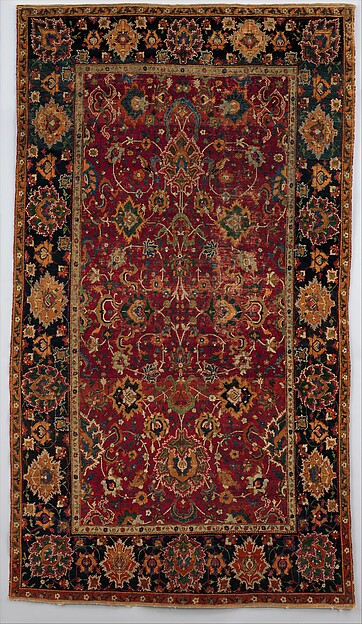
Garden designs are old. The Metropolitan Museum names vase and garden carpets among the common types of the 17th century (Met). For Qom, auctions document both. In 2026 Chiswick sold a signed silk Qum with a garden design in pastel shades (Chiswick, Lot 76). In 2025 the Dorotheum offered a Qom with a flock of birds on a flowering tree (Dorotheum).
The tree of life is often named as a Qom motif (Wikipedia: Qom rug; rugman.com). No scholarly source on its meaning in the Qom carpet was found.
Pictorial carpets
Rugman names portraits and pictorial scenes. Bakhtiyar speaks of weavers who knot pictorial scenes as well as flowers (rugman.com; bakhtiyar.com, both trade claims). Britannica names Kashan, Kerman and Tabriz as the main sources of pictorial and prayer carpets (Britannica: Kashan carpet). Britannica does not mention Qom here.
Overview
| Design | Persian | General specialist source | Evidence for Qom |
|---|---|---|---|
| Medallion and corners | lachak-toranj | Iranica iv | Wikipedia; Dorotheum 2023 |
| Dome medallion | gonbad | – | Nagel 2019 (catalogue) |
| Shah Abbasi palmettes | shah-abbasi | Iranica iv | trade only |
| Arabesque | eslimi | Iranica iv | trade only |
| Hunt | shekargah | Iranica ix (Kashan) | Dorotheum 2020 |
| European rose | gol-farang | Alzahra University study | Wikipedia (state gift 2019) |
| Prayer niche | mehrabi | Iranica iv | trade only |
| Compartment design | kheshti | none found | trade only |
| Garden | – | Met essay | Chiswick 2026 |
| Bird and tree | – | – | Dorotheum 2025 |
What buyers value in the design
A study in the journal Jelve-ye Honar by Seyed Mohammad Mahdi Mirzaamini and Mohammadreza Shahparvari examined more than 100 new Qom carpets in 2017 (Ensani). It also surveyed buyers. What mattered most to them was colour and the distribution of colour. Then followed innovations within traditional designs, fineness, regular knotting and the sheen of the silk.
The study reaches a remarkable finding about the dense, small-scale field motifs. Despite all their variety, they showed little formal variation. Their task, it says, is above all to fill the surface and to create a variety of colour. Overall, the Qom carpet remains committed to the principles of traditional art. In the last two decades, however, it has developed from an object of use into a luxury object.
Colours
Wikipedia names blue, red and ivory as typical Qom colours (Wikipedia: Qom rug). Bizsan describes a classic palette of ivory, red, navy, turquoise and shades of yellow, and a newer trend towards pastels (bizsan.hu, trade claim). A Dorotheum lot of 2016 was salmon pink (Dorotheum), and the garden design at Chiswick was in pastel colours. No uniform Qom palette can be derived from the sources.
The sources disagree
The trade’s lists of designs overlap only in part. Rugman names, among others, the Kashan “Koran frame”, vase-and-hunting combinations and portraits (rugman.com). Bizsan names boteh, compartments and paradise gardens (bizsan.hu). Little Persia adds gol-o-bolbol, rose and nightingale, and ascribes symbolic meanings to the designs, without evidence (Little Persia). Beytoote additionally lists stripe designs (mohramat), inscription borders and “geometric Joshaqani” (beytoote.com). This variety tends to confirm the thesis of an open repertoire rather than establish a canon. Symbolic interpretations of individual motifs are not attested for Qom in any specialist source examined.
Related topics
- Reading a Persian carpet: field, medallion, corners, borders
- Shah Abbasi palmettes
- Hunting and animal carpets
- Gol-farang and European influence
- Kheshti: the compartment design
- Prayer rugs (mehrabi)
Sources
- Carpets iv. Designs, motifs and patterns (Annette Ittig) – Encyclopaedia Iranica
- Carpets ix. Safavid Period (Daniel Walker) – Encyclopaedia Iranica
- Carpets xii. Pahlavi Period (Willem M. Floor) – Encyclopaedia Iranica
- Carpets xiv. Tribal Carpets (Siawosch Azadi) – Encyclopaedia Iranica
- Kashan carpet – Britannica
- Carpets from the Islamic World, 1600–1800 (Marika Sardar) – The Metropolitan Museum of Art
- Carpet, T.438-1976 – Victoria and Albert Museum
- MAK, Vienna reopens permanent carpet gallery – HALI
- The Effect of Westernization (Golfarang) on Kashan’s Architecture Decoration and Carpets – Jelve-y Honar, Alzahra University
- The Dodecagon Carpet of the Tomb of Shah Abbas II: A Structural Study – Iranian Journal for the History of Islamic Civilization
- Lot: Ghom silk, 23.03.2016 – Dorotheum
- Lot: Ghom silk, hunting scenes, 21.10.2020 – Dorotheum
- Lot: Ghom silk 11 x 11, 24.02.2023 – Dorotheum
- Lot: Ghom Silk Finest Quality, 2025 – Dorotheum
- Lot 76: Signed silk Qum carpet, 27.01.2026 – Chiswick Auctions
- Lot 587: Seidenghom, Meistermanufaktur Jamshidi, 27.02.2019 – Nagel Auktionen (via veryimportantlot)
- Mirzaamini, Shahparvari: Aesthetic analysis of Qom carpets (new Qom carpets) – Jelve-ye Honar 17, 1396/2017, via Ensani
- Oral history: the role of the Jamshidi family in the Qom carpet, 20.10.2022 – Hawzah News (oral history, the participants’ own statements)
- Qom rug – Wikipedia
- Haj Hossein Erami, founder of the Farsh-e Abrisham-e Hossein Erami brand, 21.07.2023 – carpetour.net (trade portal; company portrait)
- Ashnaei ba farsh-e Qom – Beytoote (Iranian popular portal, without references)
- Qum rugs – Rugman (trade claim)
- Qom (Ghom) handmade silk rugs of Iran – Bizsan (trade claim)
- Qom rug history and origin guide – Little Persia (trade claim)
- Qum – persianrugs.com.au (trade claim)
- Silk Qum carpet – Farnham Antique Carpets (trade claim)
- Fine Qum Silk Rug, Kheshti – Djoharian (trade claim)
- Qum Rugs: The Definitive Guide – Bakhtiyar (trade claim)